What Colors Were Used to Decorate in Art Deco
Art Deco Colors
Dunn-Edwards is pleased to innovate the next set of our series in the Then, Now & Forever® collection. The Roaring '20s delivered exciting changes to the architectural landscape, bringing a new, stylized modern design to the forefront. Art Deco and Art Moderne helped define an heady period of design in American architecture, and these styles of buildings that dot the American West showcase some of the best studies of this mod blueprint.

New Mission Theater. San Francisco, CA. 1917/1932
Fine art Deco and Moderne (1920s - 1940s)
Background:
In 1925 in Paris, the Exposition Internationale des Arts Decoratifs et Industriels Modernes was France's attempt to rebuild after World War I and to re-institute itself as a leader in the world of decorative arts. Designs were based in tradition, merely with a modern twist. "In event, the greater number of the Exhibition buildings owed far more to tradition than was at first apparent, and were not then much attempts at the new, merely for the sake of novelty as, simply, efforts to suit architecture to changed conditions then to keep it a living Fine art."i Although the United States decided not to participate, a grouping of delegates attended, and its reports allowed Americans to see a new design course heavily influenced by exotic ornament. The state of the economy led architects to a desire to economize building costs, thus the move to use ornamentation in a sparing fashion.
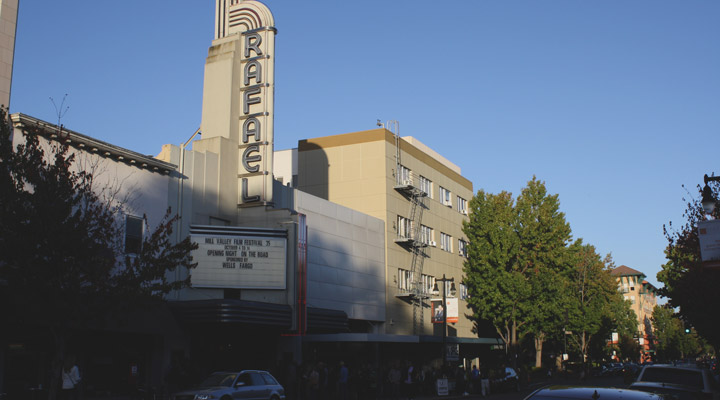
Rafael Theater, San Rafael, CA. 1938.

California Theater, Pittsburgh, CA. 1920/1930s. Photo Credit: David Wakely
Equally a move, Art Deco encompassed architecture, art, fashion and furniture. Information technology incorporated stylized versions and repeating patterns of traditional decorative elements such as animal forms, floral patterns and geometric shapes. Large expanses of glass cake or richly colored opaque colored glass, called Vitrolite, were popular. Buildings were monolithic in form, using shapes fabricated popular in the Bauhaus school, with applied ornament to provide decorative interest. Vertical panels and the absence of a cornice gave the illusion of height as a ways to advise modernity and progress. It was a that was used rarely in domestic compages but saw heavy employ in public structures and apartment buildings. Movie theaters were a particularly popular forum for its use, where the introduction of exotic and unfamiliar motifs such as Mayan temples, Egyptian pyramids and Native American art had a natural outlet. The use of mosaics, terracotta and cast stone to mimic real stone were all components of a fanciful blueprint that provided an escape from the era'southward wars and Low.
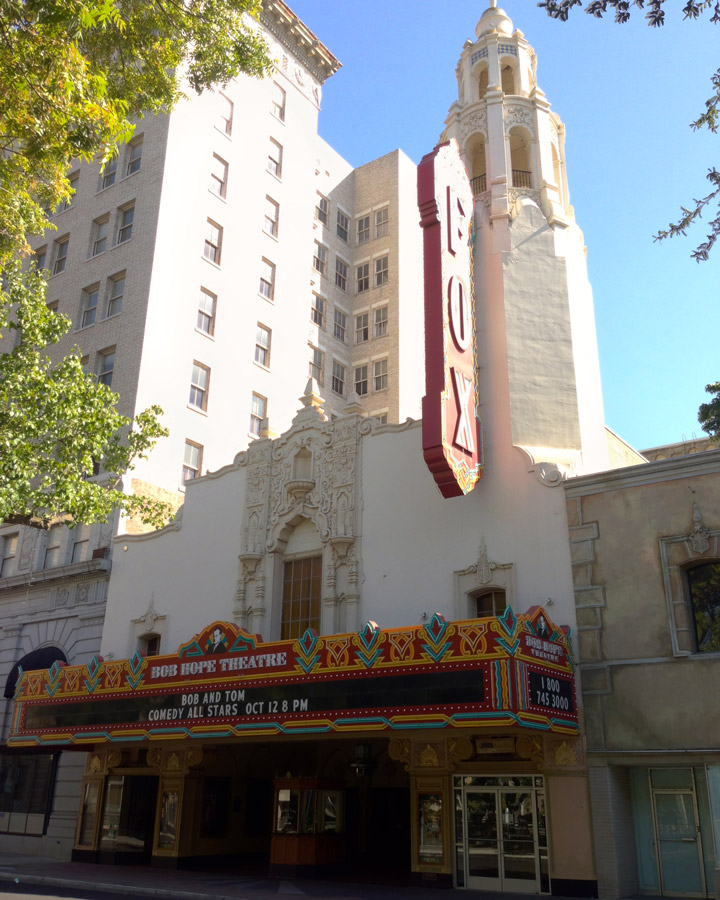
Fox Theater (now called Bob Hope Theater). Stockton, CA. Photograph Credit: Michael Aivaliotis
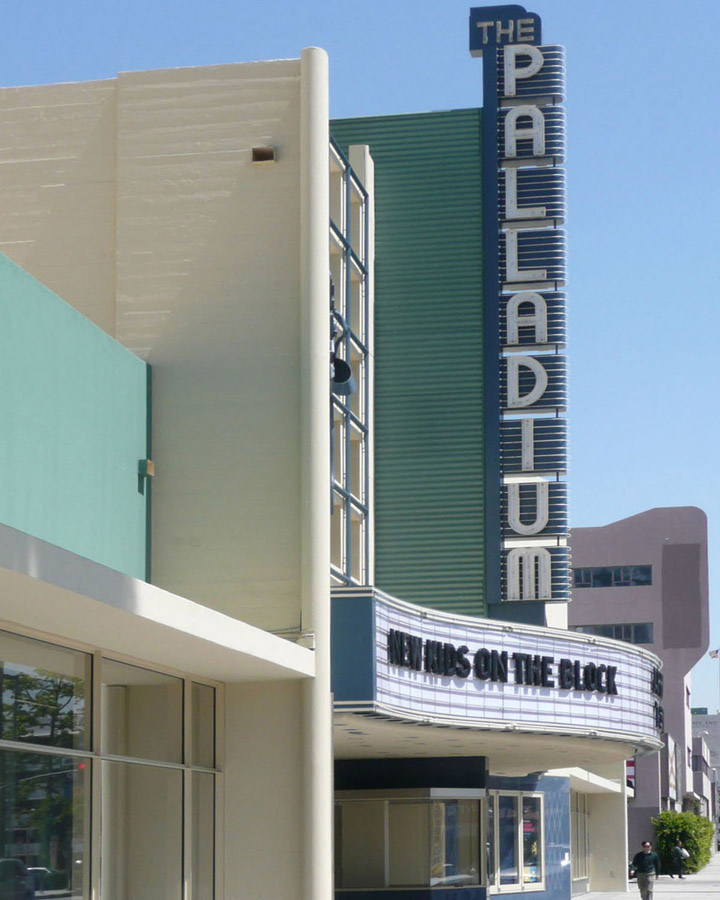
Hollywood Palladium, Hollywood, CA. 1940.
Moderne, sometimes called Streamline, was a short-lived follow-up to the Art Deco period. In contrast to its predecessor, emphasis was placed on horizontal lines. Edifice corners were curved and windows were sometimes small and round. The proliferation of new machinery provided inspiration for streamlined details with an industrial wait. As the population began moving out of urban areas, new commercial construction in suburbia took advantage of the lower structural costs associated with this — a uncomplicated form whose construction is little revealed, with minimal ornamentation.
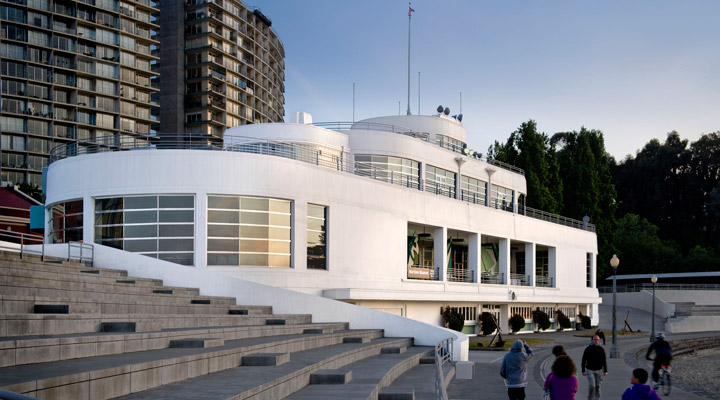
Maritime Museum, San Francisco, CA. Photo Credit: David Wakely.
Both styles reached their pinnacle in the displays of the 1939 New York World's Fair.
Color Palette Examples:
The heavy utilise of gilding and metals, such as aluminum and chrome, was contrasted and counterbalanced with the apply of color in paint and ornament. "The Art Deco typically assorted warm tans and pale shades of light-green and blue either with shiny metals or with accents of strong 'pure' colors — vehement reds, cobalt dejection, or golden yellows." two
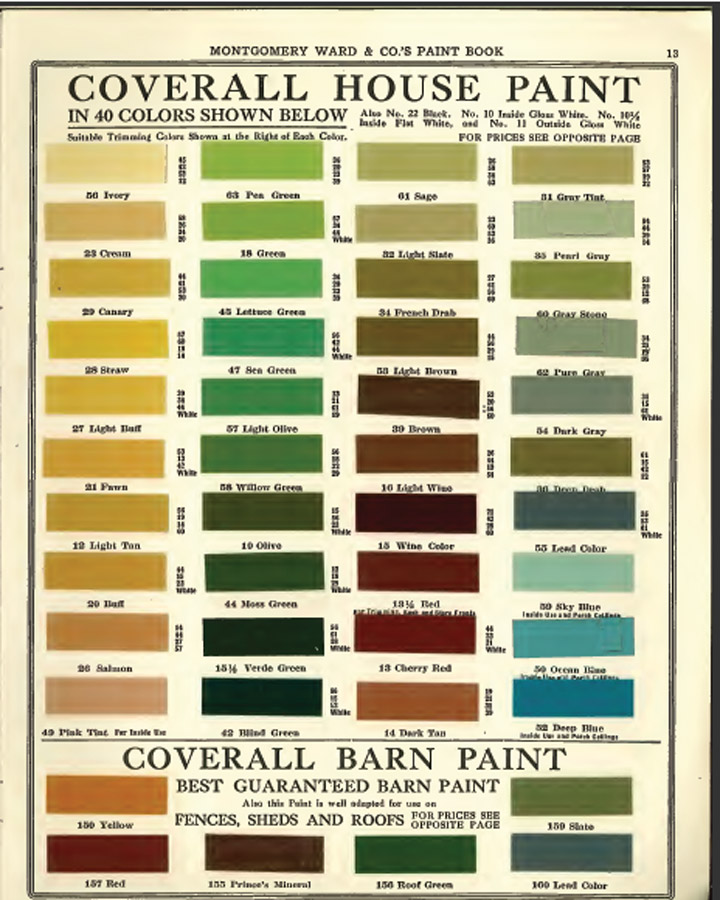
Buildings at the Paris Expo were notably painted in bright colors with accents of silver and gold. "Silverish and gold painted in lines or dusted over crude plaster surfaces gave brilliancy to many buildings." three Colorful mural decorations played a prominent role in the decorative scheme taking the place of architectural detailing.
Beaux Arts (U.S. influence 1880-1920)
Groundwork:
The term "Beaux Arts" specifically references the design theory taught at the École des Beaux Arts in Paris, simply is by and large interchangeable with the term "neoclassical." The Beaux Arts training emphasized the mainstream examples of Imperial Roman architecture between Augustus and the Severan emperors, Italian Renaissance, and French and Italian Baroque models.


Huntington Art Gallery, San Marino, CA. 1911.
The Beaux Arts was nearly influential on American architecture between 1880 and 1920 iv, when non-French architects began focusing more toward their own academic architectural influences, rather than a pure focus on Paris architecture. American architects of the Beaux Arts generation often returned to Greek models, which had a strong local history in the American Greek Revival of the early 19th-centuryv. Ane of the nigh prominent California architects of the time, Julia Morgan, was the first female person pupil of the institute in Paris and helped greatly influence the American West landscape with this style of compages, most famously the Hearst Castle in San Simeon, California.6
Although at that place is some overlap in the timeframe, Beaux Arts/Neoclassical is distinctly dissimilar from the Art Deco/Moderne style. The Beaux Art is a bit intertwined with the Art Deco story considering a number of historic theaters, including several in our paint analyses (e.g., the New Mission and the California theaters) were originally built in a very neoclassical/Beaux Arts style and later redecorated in the Art Deco style. The styles are really very distinct from one some other — simply the colors are overlapping due to this history of renovation, which often included a complete Fine art Deco redecoration at some spaces, and the retentiveness of Beaux Arts elements in other areas.
Click here to download the master color palette collection.
Noted References:
1. Reports on the Present Position and Tendencies of the Industrial Arts as indicated at the International Exhibition of Modernistic Decorative and Industrial Arts, Paris, 1925; Department of Overseas Trade, p.39.
2. The National Trust Guide to Art Deco in America, David Gebhard, Preservation Press, John Wiley & Sons, Inc., NY: 1996
3. Study, p. fifty.
4. Clues to American Architecture, Klein and Fogle, 1986, p.38
5. The Influence of the École des Beaux Arts on the Architects of the The states, James Philip Noffsinger, Washington DC., 1955, Cosmic University of America Press
6. San Simeon revisited: the correspondence between builder Julia Morgan and William Randolph Hearst, Morgan, J. Hearst, W. R., & Loe, N. E., 1987. San Luis Obispo, Calif: Library Assembly, California Polytechnic Country University
Source: https://www.dunnedwards.com/colors/specs/posts/then-now-and-forever-r-the-art-deco-art-moderne-and-beaux-arts-collection
0 Response to "What Colors Were Used to Decorate in Art Deco"
Postar um comentário